Turbo Range: earn fees on your stocks
A guide to understanding why holding stocks on blockchain opens up new yield opportunities — and how Turbo Range makes them accessible to everyone.
1. What changes with on-chain stocks
With a traditional broker, stocks sit idle in your brokerage account: the only way to profit is to sell at a higher price. If the market moves sideways, your capital produces nothing.
"On-chain" stocks are tokenized versions of real securities (Tesla, Nvidia, Apple…) recorded on blockchain, pegged 1:1 to the price of the underlying stock. The difference? The blockchain is a market active 24/7: every trade generates a fee — and in the blockchain world, anyone can collect it.
Imagine a currency exchange booth at the airport. When a traveler exchanges euros for dollars, the exchange operator earns a fee. Turbo Range turns you into the exchange operator: your capital facilitates trades, and for every transaction you collect a fee — automatically, 24/7, without having to do anything.
This activity is called liquidity providing: your assets are used as counterparty for other users' trades. The more the price fluctuates, the more trades occur, the more fees you earn — volatility becomes your ally.
2. What is a liquidity pool
Before understanding Turbo Range, it's helpful to grasp the underlying mechanism: the liquidity pool.
A liquidity pool is a shared deposit of two assets — for example Nvidia and USDC — managed entirely by an automated program (called a smart contract) that lives on the blockchain. There is no human intermediary: everything is governed by code.
How it works
The price within the pool is not set by a central operator, but is determined by a mathematical formula that automatically adjusts the ratio between the two assets. When someone buys Nvidia from the pool, the amount of Nvidia decreases and its price rises; when someone sells, the opposite happens. The mechanism constantly self-balances.
Anyone can provide liquidity to a pool — you don't need to be an institution or have special permissions. Simply deposit your assets and start earning a share of the fees generated by trades.
In summary: a liquidity pool is a decentralized and automated market where anyone can participate as a "counterparty" to trades — and earn from fees. The smart contract ensures that everything works transparently, without anyone being able to manipulate the process.
How fees are generated — Video
A short video illustrating the mechanism of earning fees from trades.
3. How Turbo Range works
Turbo Range is DeGate's tool that makes liquidity providing simple, automatic, and accessible even to those with no cryptocurrency experience.
The process can be summarized in three steps:
- Choose the asset Select which market you want to operate in: US stocks (Tesla, Nvidia, Apple…), gold, or Bitcoin.
- Set a price range Define a price band within which you want to provide liquidity. The system automatically suggests an optimal range. As long as the price stays within that range, fees accumulate.
- Deposit and go You can invest with a single token (e.g., USDC only) or with both tokens of the pair (e.g., Nvidia + USDC). The system automatically handles the conversion and allocation within the pool. With one or two clicks, the position is active.
Once the position is opened, the system converts and distributes the capital between the two assets of the pair based on the current price and the chosen range. From that point on, every trade that occurs within the range generates fees in your favor.
Your funds always remain in your wallet. DeGate has no access, does not hold custody, and cannot move your capital. Only you can open, modify, or close the position. This model is called "self-custody."
4. How the position changes as price moves
Your position is composed of two assets (e.g., Nvidia + USDC). The ratio changes automatically based on the price. Use the slider to simulate it:
The three possible scenarios
The price stays within the range
Generates fees constantly, 24/7, from every trade within the range.
The price rises above the upper bound
The position becomes 100% USDC. You exit in profit: you gradually sold on the way up + collected all the fees.
The price drops below the lower bound
The position becomes 100% token. The dollar value decreases, but the accumulated fees cushion the loss. You can hold, realign the range, or close.
Key point: fees earned within the range are yours and are never returned. In the positive scenario they amplify the gain; in the negative one they reduce the effective loss.
5. Positioning strategies
You can position the range strategically based on your market outlook. The choice of range is itself a strategy — here are the three main ones:
● Take Profit — "You're bullish"
Range above the current price
If the price rises and enters the range, the position gradually sells the token for USDC, earning fees on every trade. If it exceeds the upper bound, you end up with 100% USDC — an automatic take profit + fees.
Ideal when: you believe the asset will rise and want to cash out gradually, without risking selling too early or waiting too long.
● Buy the Dip — "You want to accumulate at a discount"
Range below the current price
If the price drops and enters the range, the position gradually buys the token with your USDC, at increasingly lower prices, while earning fees. If it drops further, you have 100% token accumulated at a discount.
Ideal when: you think the asset may dip in the short term but believe in its long-term value. The range accumulates for you, without monitoring.
⇌ Neutral — "Maximize fees"
Tight range centered on the current price
The tighter the range, the higher the fee density per dollar invested. Every price swing generates trades and fees in your favor. It's the ideal strategy for sideways markets or assets with high intraday volatility without a clear trend.
Ideal when: the market is consolidating and you want to maximize yield. Requires more frequent monitoring because a tight range can be "broken" by a sudden move.
Quick guide
| Your outlook | Strategy | Range | Outcome |
|---|---|---|---|
| ↑ It will rise | Take Profit | Above the price | Sell on the way up + fees |
| ↓ It will drop | Buy the Dip | Below the price | Accumulate at a discount + fees |
| → Sideways | Neutral | Tight, centered | Maximum fees |
The key point: unlike simple "buy and hold," Turbo Range allows you to express your market outlook — and earn fees in any case, as long as the price stays within the range.
6. Comparison: simple holding vs. Turbo Range
To understand the added value of Turbo Range, let's compare classic "buy and hold" with an active Turbo Range position.
| Classic holding | Turbo Range | |
|---|---|---|
| Profit if price rises | ✓ Yes | ✓ Yes + fees |
| Profit if price is stable | ✗ No | ✓ Yes, from fees |
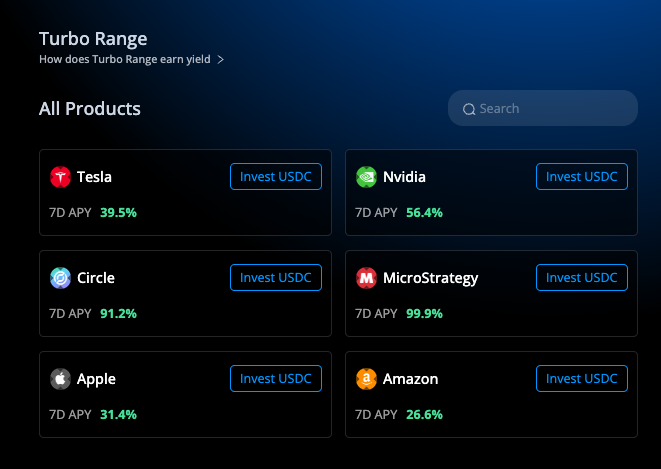
| Indicative annualized yield | Price appreciation only | 40%–100%+ from fees |
| Market operating hours | Mon–Fri, exchange hours | 24/7, including weekends |
| Capital custody | With the broker | In your wallet |
| Intermediaries required | Broker, bank, custodian | None (self-custody) |
Classic holding and Turbo Range are not mutually exclusive. You can allocate a portion of your portfolio to Turbo Range to generate additional yield, while keeping the rest in traditional mode.
7. Calculate potential returns
To visualize capital growth over time, a compound interest calculator is available with rates updated in real time from Turbo Range pools.
The tool allows you to set initial capital, yield rate, and time horizon, showing both the final balance and the year-by-year breakdown.
Compound Interest Calculator
Simulate capital growth with real rates from Turbo Range pools. Includes chart and annual breakdown.
The calculator is useful for making tangible the potential of reinvesting fees over 1, 3, or 5-year horizons.
8. Things to consider
Turbo Range offers interesting opportunities, but it's important to be aware of certain aspects:
Price risk
If the asset's price drops below the range, the position converts entirely into the token and the dollar value will be lower than the initial investment. For this reason, it's advisable to use Turbo Range only on assets you are willing to hold even in case of a decline.
Optional active management
If the price moves out of the range, the position stops generating fees. You can choose to wait, realign the range, or close the position. There is no obligation to intervene, but periodic monitoring is recommended.
Blockchain context
Stock tokens live on blockchain (Solana/Ethereum). Interaction is done through a digital wallet. The DeGate app simplifies the experience, but it remains a different environment from a traditional brokerage account.
Variable returns
The indicated returns (40-100%+) are based on historical data and may vary. Periods of low volatility or low trading volume produce lower fees.
9. Summary
On-chain stocks are not just securities: they are productive instruments. With Turbo Range, you make your capital available for trades and collect a fee on every transaction — like a digital currency exchange. The result is additional yield beyond mere price appreciation, active even in sideways markets, 24 hours a day, without intermediaries, with your funds always in your wallet.
For further information, simulations, or contacts: